Finding a garment manufacturer in Vietnam is easy. Finding the right manufacturing partner for your product is harder. A factory may offer a competitive quotation but still be unsuitable for your construction, quality expectations, communication needs, or export requirements.
Before placing a bulk order, international apparel buyers should evaluate more than price. These seven questions can help you identify a supplier capable of supporting long-term production.
1. Does the Factory Specialize in My Product Category?
Not every garment factory is equally strong in every product. Activewear, casualwear, underwear, kidswear, uniforms, and workwear require different fabrics, machinery, sewing skills, and quality standards.
Ask which categories the factory produces regularly and request relevant samples. A factory with the right specialization will usually understand potential construction problems before production begins.
2. Can You Work From My Tech Pack or Physical Sample?
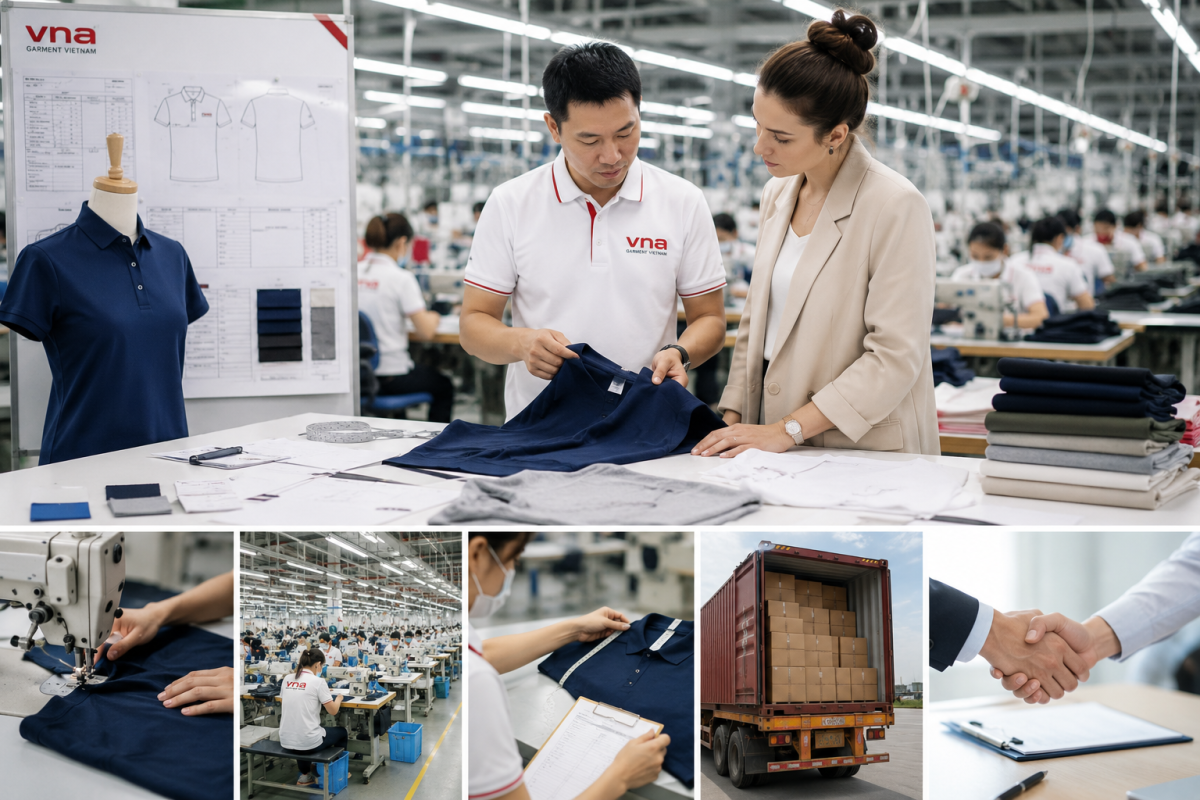
If you already have an approved product, the manufacturer should be able to evaluate your tech pack or reference sample and explain how it will be reproduced.
A professional supplier should review construction, measurements, materials, trims, quantity, packaging, and target delivery date before confirming feasibility.
3. How Do You Source and Approve Materials?
Fabric is one of the biggest variables in garment quality.
Ask how the supplier matches fabric weight, composition, stretch, hand feel, color, shrinkage, and finishing.
If your market requires certified materials, confirm whether the supplier can source fabrics with certifications such as GOTS, OCS, GRS, FSC, or OEKO-TEX® when applicable.
4. What Happens During Quality Control?
Final inspection alone is not enough. Problems are easier to correct while production is still running.
Ask whether the supplier checks materials before cutting, inspects cutting accuracy, performs inline and midline inspections, verifies measurements, checks packing, and conducts final inspection before shipment.
A structured quality-control process can significantly reduce the risk of discovering defects only after the goods reach your warehouse.
5. Who Will Communicate With Me During Production?
International buyers need clear updates when samples are delayed, materials change, measurements fall outside tolerance, or production schedules shift.
Look for a supplier with a dedicated merchandising or buyer-facing team that can provide regular updates and coordinate directly with the factory floor.
Clear communication helps buyers make faster decisions and prevents small production issues from becoming larger problems.
6. Can the Supplier Handle Export Requirements?
Producing garments is only part of the job.
Export orders may also involve commercial documents, certificates of origin, packing requirements, shipment preparation, and logistics coordination.
Ask who is responsible for these tasks and whether the supplier has experience supporting international shipments.
7. What Happens If One Factory Is Not the Best Fit?
A supplier that forces every order into one production line may not always deliver the best result.
VNA Garment operates its own factory while coordinating a network of specialized partner workshops. This allows projects to be evaluated according to product type, materials, construction, capacity, and quality requirements rather than automatically assigning every order to the same production floor.
Choose Capability, Control, and Accountability
The best garment manufacturer in Vietnam is not necessarily the supplier with the lowest quotation. It is the partner that understands your product, communicates clearly, controls quality throughout production, and takes responsibility for the manufacturing process.
Before requesting a quotation, prepare your tech pack or reference sample, target quantity, destination market, delivery date, and quality requirements. Complete information helps a manufacturer assess your project more accurately and recommend the right production route.